 |
The
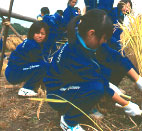
“Mochizuki off-campus program,” held for 4 days and 3
nights, incorporates farm work at fields and paddy
fields. In an all-female environment, not only do they
fulfill their roles, such as “harvesting the rice
plane,” “banding the rice plants together,” and “hanging
the sheaves on the hazeppo,” but also they have to
coordinate in manual labor and groups on their own.
The farm work
begins with rice-planting at the end of May, followed by
weeding the rice fields, planting the sweet corn-seeds,
planting the seedling of pumpkins, egg plants, sweet
potatoes, and planting potatoes. In the fall, we
harvest the rice-plant and vegetables and prepare the
soil for the fields after harvest. One of the
characteristics is cultivating a sense of solidarity in
the students by sharing responsibilities beyond grade
levels. For example, the first year junior high school
students take charge of seeding at the beginning of the
spring, and the third year junior high school students
take charge of harvesting the rice plants in the fall.
In addition, not
only is farm work an occasion to learn the importance of
labor, but it also leads to fostering a sense of
responsibility and cooperation from group work, and
bring about a sense of gratitude toward food.
By experiencing
what it takes to grow rice and vegetables, students
cultivate a sense of gratitude toward food and a sense
of valuing things. |